A running toilet is one of the sneakiest ways to waste water, because half the time you don’t even know it’s happening. It’s not the dramatic overflow that gets your attention. It’s the quiet trickle that runs all day and all night while you’re at work, asleep, or out of town, and shows up a month later as a water bill that makes you do a double take.
A toilet that runs constantly can waste hundreds of gallons a day. The good news is that most running toilets come down to one or two cheap parts, and you can catch the problem in about two minutes.
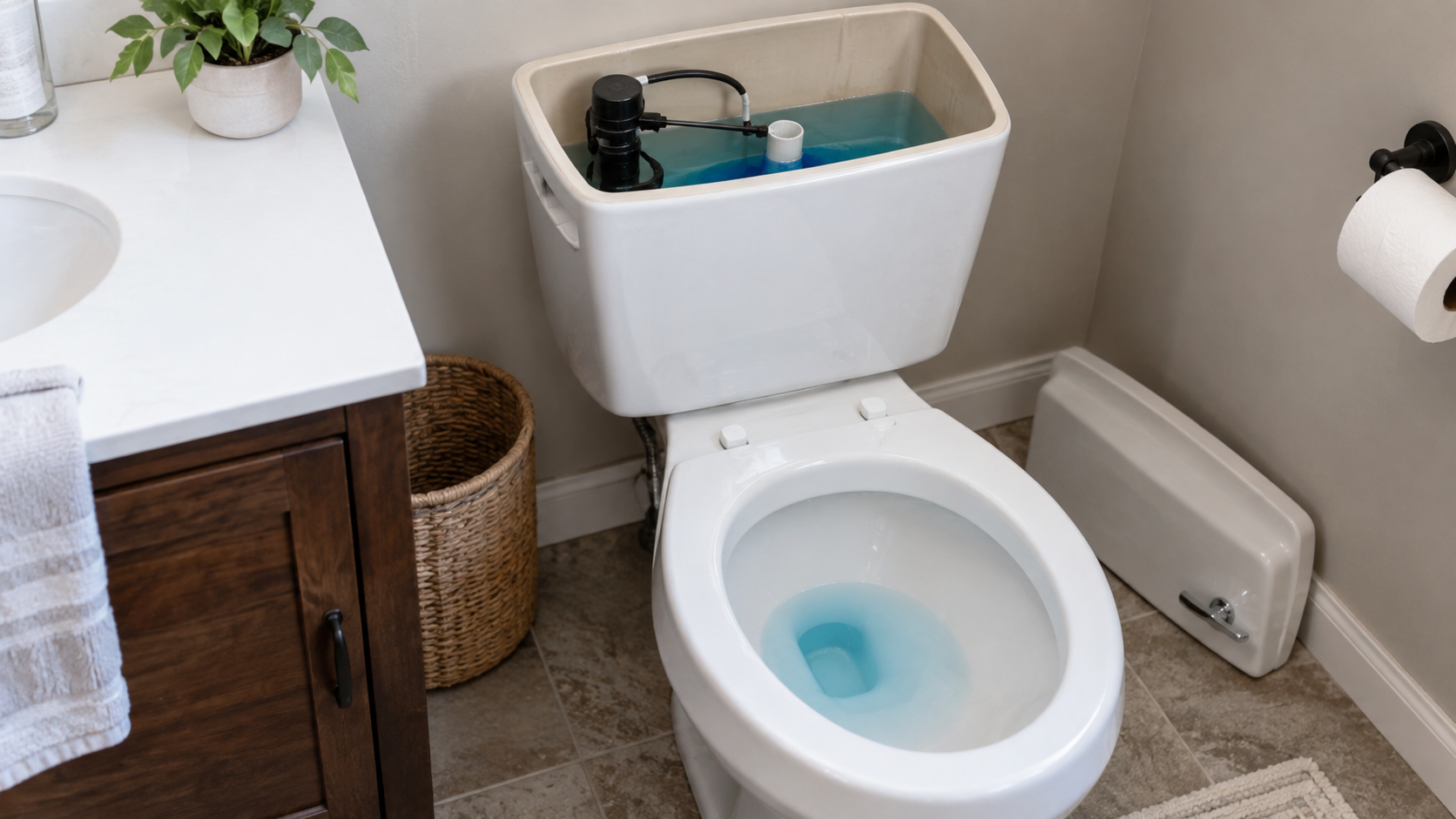
If you suspect a toilet is running but you’re not sure, here’s the trick. Take the lid off the tank and drop in a few drops of food coloring, or a colored dye tablet if you have one. Don’t flush. Walk away for about fifteen minutes.
Come back and look in the bowl. If the color has crept down into the bowl water, you’ve got a leak. Water is slipping from the tank into the bowl when it shouldn’t be, and that’s exactly the silent waste running up your bill. If the bowl water is still clear, that toilet is sealing fine.
It’s the simplest home plumbing test there is, and it tells you for certain which toilet is the culprit when you’ve got more than one in the house.
Most running toilets trace back to one of a few parts inside the tank, and none of them are expensive.
The flapper is the usual suspect. That’s the rubber seal at the bottom of the tank that lifts when you flush and drops back to seal the tank. Over time it gets stiff, warped, or coated with mineral buildup, and it stops sealing. Water slips past it into the bowl, the tank slowly empties, and the fill valve kicks on to top it back up. That cycle, over and over, is your running toilet.
The fill valve itself can be the problem too. If it doesn’t shut off at the right level, water keeps flowing into the overflow tube and down into the bowl. You’ll sometimes hear this one as a faucet-like hiss that won’t quit.
The last common one is a flush chain that’s too long or too short. Too long and it gets caught under the flapper so it can’t seal. Too short and it holds the flapper open a crack. An easy thing to check and adjust.
A flapper is a cheap part and a straightforward swap for a lot of homeowners. Shut off the water at the valve behind the toilet, flush to empty the tank, unhook the old flapper, and clip the new one in. Adjusting a flush chain is even simpler. If that’s the whole problem, you’re back in business for a few dollars.
Sometimes it’s not just the flapper. If you’ve swapped it and the toilet still runs, if the fill valve needs replacing, if the toilet rocks or leaks around the base, or if you’ve just got a toilet that’s been limping along for years, it’s worth having someone make it right instead of chasing part after part. And if you’ve been staring at a mystery water bill and can’t find where it’s going, we can help you track it down.
If a running toilet is driving you crazy or padding your water bill, give Steakley Plumbing a call at 615.254.5325. We work all over Nashville and Middle Tennessee, and this is a quick, everyday fix we handle all the time.